If you’re self-employed (sole proprietor, independent contractor, freelancer, or gig worker), you report your business results on Form T2125 – Statement of Business or Professional Activities. The CRA expects your income and expenses to be reasonable, supported by documents, and allocated correctly between business and personal use.
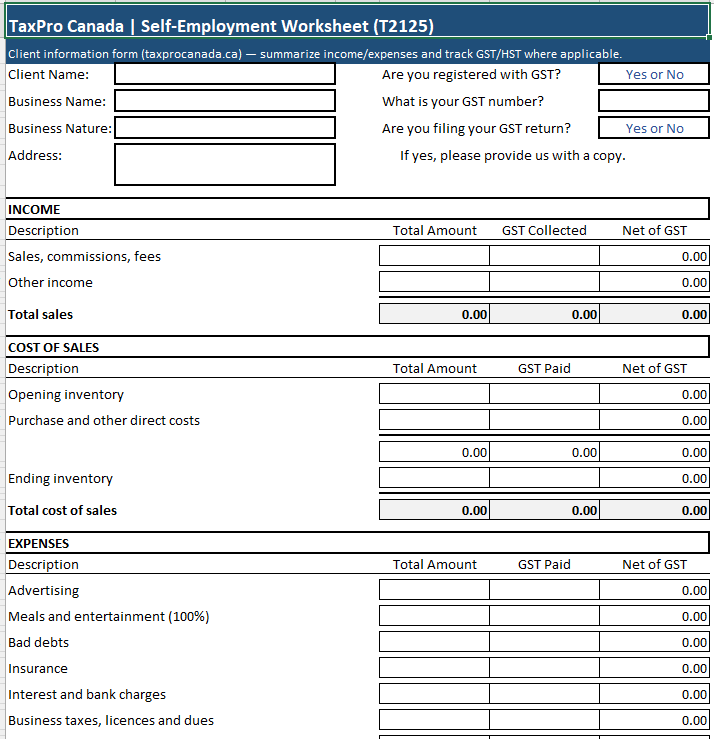
To make this easy for clients, we use a structured Self-Employment Worksheet (T2125) (the attached form). It mirrors the CRA’s logic: Income → Cost of Sales → Expenses → CCA (capital assets) → Home Office → Vehicle → Net business income.
1) What the CRA actually cares about (and what triggers problems)
“Reasonable” and “to earn business income”
CRA’s baseline rule is simple: you can deduct reasonable current expenses incurred to earn business income—but only the business portion. Personal expenses don’t belong on the T2125.
Current expense vs. capital expense (CCA)
A frequent mistake is claiming a large purchase (laptop, equipment, tools) as a regular expense. If it’s capital property, you generally claim it through Capital Cost Allowance (CCA) over time, not as an immediate 100% write-off.
GST/HST interaction (CPA best practice)
If you’re registered for GST/HST and you claim Input Tax Credits (ITCs), your bookkeeping should separate GST/HST from the expense (otherwise you may “double benefit”). CRA discusses ITCs and how they work for eligible purchases used in commercial activities.
2) How to use our T2125 Self-Employment Worksheet (step-by-step)
A) Business profile + GST/HST section (top of the form)
- Business name, nature, address
- GST/HST registration and GST/HST number
- Whether you filed GST/HST return (and provide a copy)
Why it matters: this affects how expenses should be recorded and whether you may have ITCs.
B) INCOME
Enter your gross income (sales/fees/commissions) and any “other income.”
CPA best practice: reconcile this to bank deposits + invoices (and note any cash income).
C) COST OF SALES (if you sell goods)
Track:
- Opening inventory
- Purchases/direct costs
- Ending inventory
This helps calculate gross profit properly (and avoids “missing” inventory adjustments).
D) EXPENSES
The worksheet groups expenses like CRA’s T2125 expense categories (advertising, insurance, interest, office supplies, etc.). CRA’s T2125 guidance emphasizes claiming only the business part and keeping expenses reasonable.
Important: Meals & entertainment are usually limited to 50% of the amount (subject to conditions).
E) CAPITAL ASSETS (CCA)
List major purchases (equipment, computers, tools, furniture, etc.) separately. CRA explains that CCA is claimed by class and is different from current expenses.
F) HOME OFFICE (business-use-of-home)
If you work from home, you can claim the business portion of eligible home expenses in the T2125 “business-use-of-home” calculation.
G) VEHICLE EXPENSES
If you use a vehicle for business, you must track the business-use percentage, typically supported by a logbook. CRA allows a full logbook base year and then a simplified method (with conditions) for later years.
3) Specific, CRA-aligned ways self-employed Canadians can reduce taxes
Below are legitimate, CRA-consistent strategies that reduce taxable income when supported properly.
Example 1 — Home office allocation (often the biggest missed deduction)
Scenario: You rent a home and use a dedicated room as an office.
- Home size: 1,000 sq ft
- Office: 120 sq ft → 12% workspace
- Annual rent: $28,800
- Eligible home expenses (example): rent, utilities, internet portion, etc.
If your eligible costs are $32,000 and business use is 12%, your home office claim could be about $3,840.
CRA requires that home office expenses be calculated correctly and not claimed elsewhere on the T2125.
CPA best practices:
- Keep proof: lease, utility bills, a simple floor plan measurement
- If the space is mixed-use, use a reasonable time-based adjustment (e.g., 8 hours/day vs 24)
Example 2 — Vehicle expenses with a defensible logbook
Scenario: You drove 20,000 km total, and 6,000 km were business → 30% business use.
If your annual eligible vehicle costs are:
- Fuel + insurance + maintenance + interest/lease (example total) = $9,500
Business portion at 30% = $2,850 deduction.
CRA expects records supporting business kms, and allows a simplified logbook method after a base year (if within the CRA tolerance rules).
CPA best practices:
- Record date, destination, purpose, kms
- Keep odometer readings at start/end of year
- Store receipts digitally (CRA accepts electronic records if readable)
Example 3 — Capital assets (CCA) done properly
Scenario: You buy a $2,000 laptop primarily for business.
Instead of claiming it as “office expense,” it’s typically treated as a capital asset and written off via CCA over time. CRA explains CCA and lists classes/rates used to calculate it.
CPA best practices:
- Track purchase date, business-use %, and keep invoice
- Don’t “dump” capital items into expenses—this is a common review trigger
Example 4 — Don’t overclaim meals (and categorize correctly)
Meals & entertainment are generally 50% allowable (not 100%).
Tax-saving tip (legit):
- If something is truly advertising/promotion (e.g., branded promo materials), it may be treated differently than meals—so categorize accurately and keep documentation that supports the business purpose.
4) Recordkeeping checklist (CRA-ready, CPA-clean)
If you want smooth tax filing and fewer CRA questions, keep:
- Bank statements + credit card statements (all accounts used for business)
- Sales invoices / payment processor reports
- Receipts for major expenses (including purpose notes for gray areas)
- Vehicle logbook + odometer readings
- Home office support (lease/mortgage interest, utilities, measurements)
- Asset purchase invoices for CCA
Want us to review your worksheet before you file?
A quick review often finds:
- missed home office or vehicle allocations
- misclassified capital assets
- GST/HST handling issues
- expenses that need better support
If you’d like, upload your completed Self-Employment Worksheet (T2125) and we’ll help you finalize it in a CRA-defensible way.
(General information only — not legal/tax advice for your specific situation. We’ll confirm details based on your facts.)