
Schools and private educational institutions often operate longer days than classroom instruction alone. Parents may pay for supervision before school, after school, over lunch, or through an extended-day program.
A common question is: Can the school issue receipts that parents can use to claim the Child Care Expense Deduction?
In many cases, yes — but only for the portion of fees that truly relates to child care/supervision, not the education/tuition portion.
The key concept: child care vs. education
For tax purposes, “child care expenses” are generally amounts paid to have someone look after an eligible child so the parent (or supporting person) can work, run a business, attend school, or do eligible research.
But the rules draw a clear line:
- Education fees (tuition/program fees) are not child care expenses
- Supervision/care fees may qualify as child care expenses
In plain terms:
- Education is structured learning (curriculum, objectives, progression, evaluation).
- Child care is primarily supervision and care.
That distinction matters even when both services are provided by the same institution.
CRA’s practical approach: split the fees
If a school provides both:
- an educational program, and
- supervision/child care services (before/after school, lunch supervision, etc.),
then only the child care portion may be eligible for the Child Care Expense Deduction. The school should provide a reasonable allocation between:
- Eligible child care (supervision/care), and
- Non-eligible education/tuition
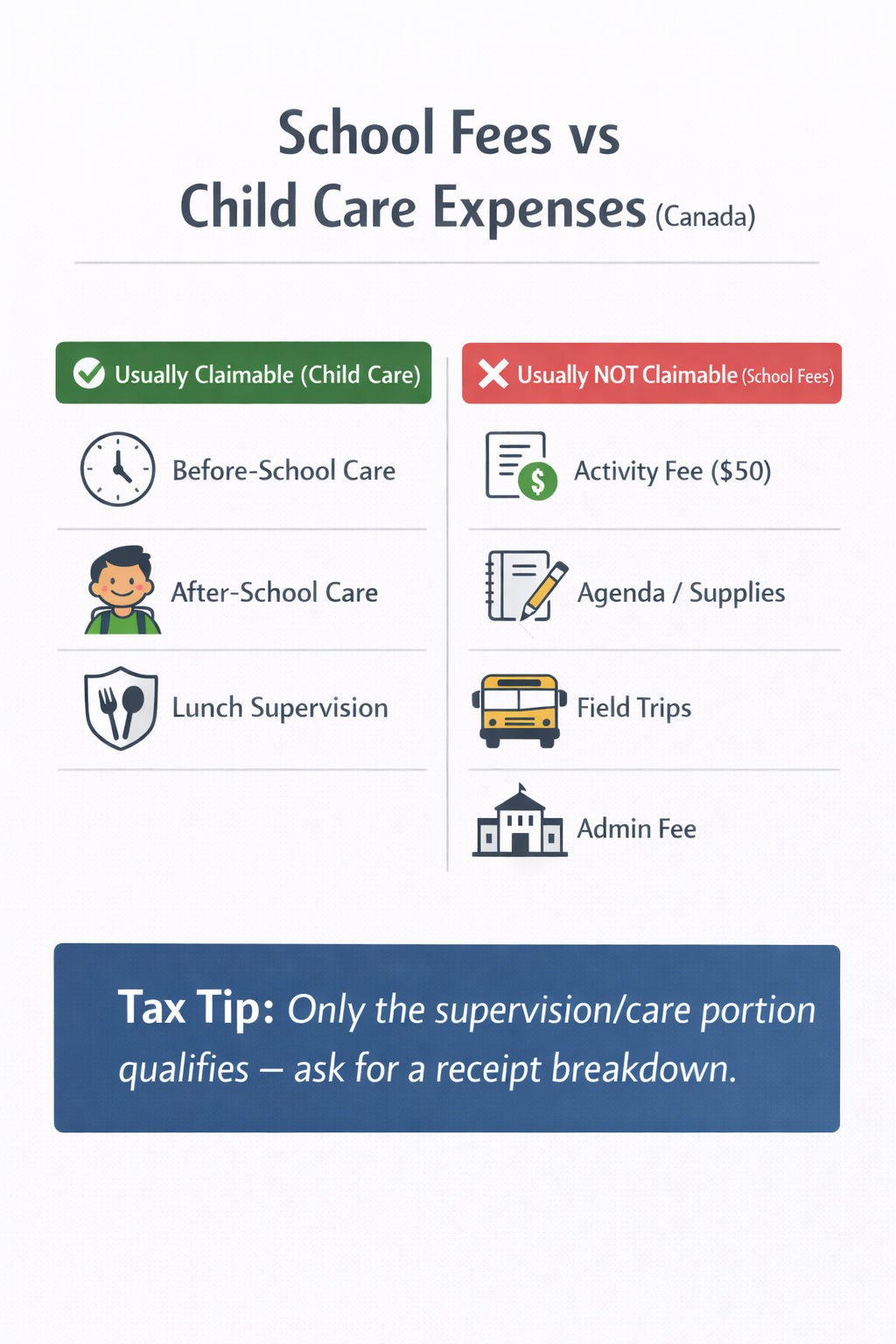
Examples of fees that may qualify (the “child care part”)
These often qualify when they are clearly supervision/care:
- Before-school supervision (e.g., 7:30–8:30)
- After-school supervision/program (e.g., 3:30–6:00)
- Lunch-hour supervision (if it’s supervision, not instruction)
What about Kindergarten and children under “compulsory school age”?
Age can matter — but it’s not the only factor.
Where a child is under compulsory school age, fees paid to an educational institution may be viewed more like child care unless the facts clearly show the fees are for a structured preschool educational program.
Bottom line: it’s not only about the child’s age — it’s about what the fee is paying for.
Guidance for schools: how to issue receipts properly
If you operate an educational institution and provide supervision/care, the cleanest CRA-friendly approach is:
1) Separate billing line items
For example:
- Tuition / academic program
- Before & after care / supervision
- Lunch supervision
- Before/after care registration fee (if applicable)
2) Use a reasonable allocation method
Common approaches include:
- Direct program pricing (best where possible)
- Staffing costs for supervision periods
- Documented schedule-based allocation (supervision hours vs. instructional hours, where appropriate)
3) Be consistent year-to-year
CRA typically focuses on whether the breakdown is reasonable and supportable, not whether it’s “perfect.”
4) Keep support on file
Maintain:
- staffing schedules and wage breakdowns for supervision hours
- program descriptions (what is supervision vs instruction)
- calendars showing instructional time vs supervision time
Guidance for parents: how to claim (and reduce CRA risk)
Parents generally claim child care expenses on line 21400, using Form T778 to calculate the allowable deduction.
To protect your claim:
- Make sure the receipt clearly identifies the child care portion (not just one lump sum labeled “tuition”)
- Keep proof of payment
- Keep the school’s breakdown/allocation
- If there’s no split between education and supervision, you may face a higher risk of CRA questions or denial for the amount claimed as child care
The common “$50 school fee” at the start of the year: is it claimable?
Parents often pay a small fee at the beginning of the school year — commonly $20–$100 per child (like $50). In most cases, this is not a child care expense.
Usually NOT claimable (most common)
If the $50 is for things like:
- activity fee / “school fee” / student agenda
- classroom supplies / photocopying
- field trips / in-school activities
- lockers, ID cards, graduation-related fees
- general administrative fees
…then it’s considered a school/education cost, not “child care” supervision.
When it might be claimable (specific cases only)
That same $50 may qualify only if it is clearly tied to child care services, such as:
- a registration/admin fee for before/after school care
- a fee specifically for lunch supervision
- a required fee to enroll in the school’s child care program (not the academic program)
Quick CPA test
Ask this simple question:
If we didn’t use before/after care, would we still pay the $50?
- Yes → almost certainly not child care
- No (only required for care program) → it may qualify
Common pitfalls (and how to avoid them)
Pitfall #1: Calling tuition “child care”
If the payment is really for the academic program, CRA can deny it as a child care expense.
Pitfall #2: No allocation / no documentation
Even if part of the fee is supervision, CRA expects a reasonable split with support.
Pitfall #3: Assuming “school = child care”
Not every service provided by a school qualifies. The focus is supervision/care, not education.
Bottom line
✅ A school can issue receipts for child care expenses — but only for the supervision/care portion, not tuition.
✅ The safest approach is clear separation and a reasonable allocation supported by documentation.
✅ Those common $50 start-of-year fees are usually not child care — unless they’re specifically tied to a child care program.
Want a quick answer for your situation?
Send the exact wording used on your invoice/receipt (for the $50 fee and any “extended day” charges), and we’ll tell you what is likely claimable — and how the receipt should be structured to stay CRA-safe.