
Owning a rental property can create steady income, but it also creates one of the most common tax problems landlords face: not all rental expenses are treated the same way. In Canada, some costs are generally deducted right away, while others usually have to be added to the property or claimed gradually over time. CRA’s basic distinction is between current (operating) expenses and capital expenses.
If you misunderstand that difference, you can end up overstating deductions, understating income, and creating problems if CRA reviews your return. The issue is especially common when landlords claim renovations, replacements, or major upgrades as if they were ordinary repairs. CRA specifically says that the two basic types of rental expenses are current expenses and capital expenses, and the classification matters.
What are operating expenses?
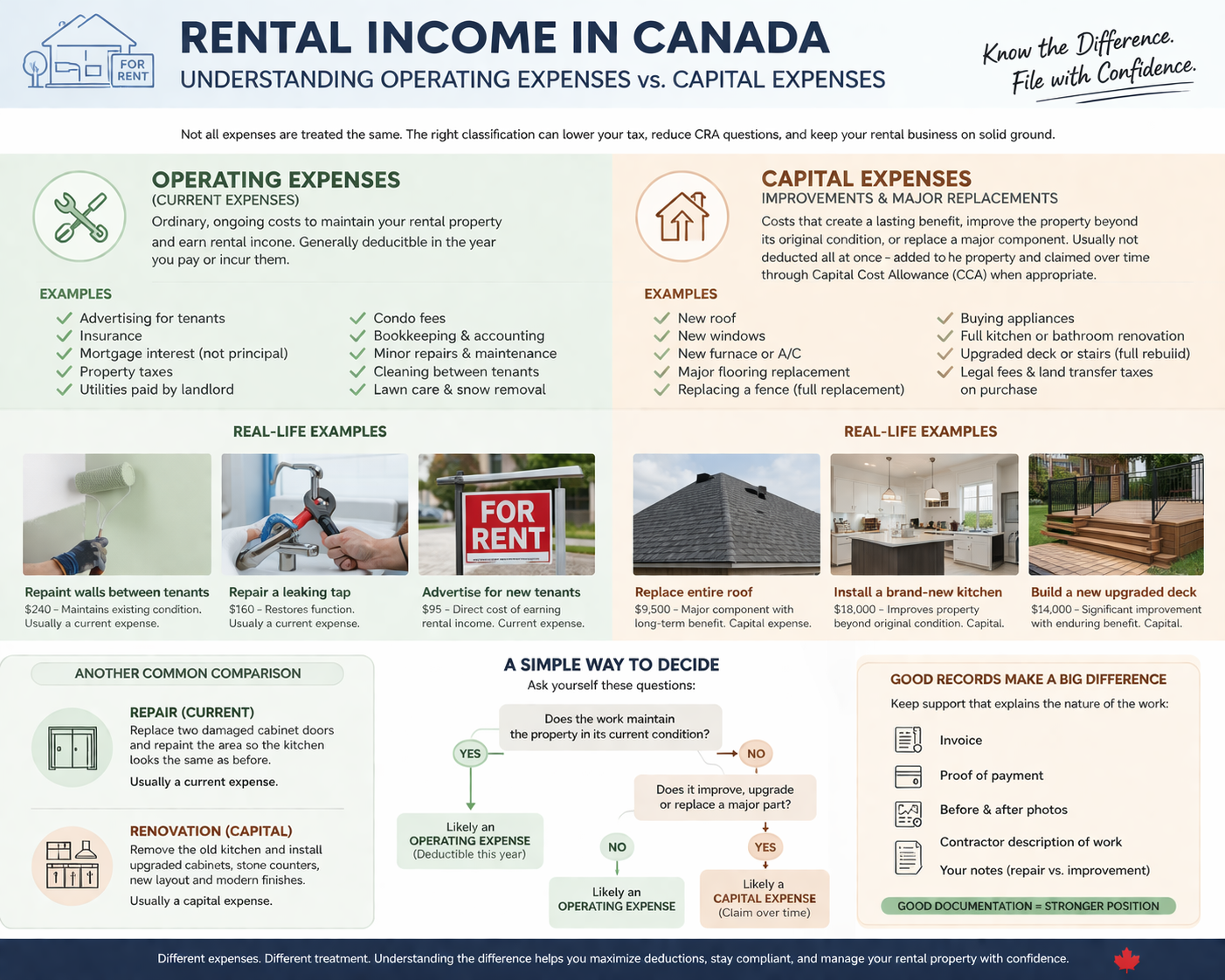
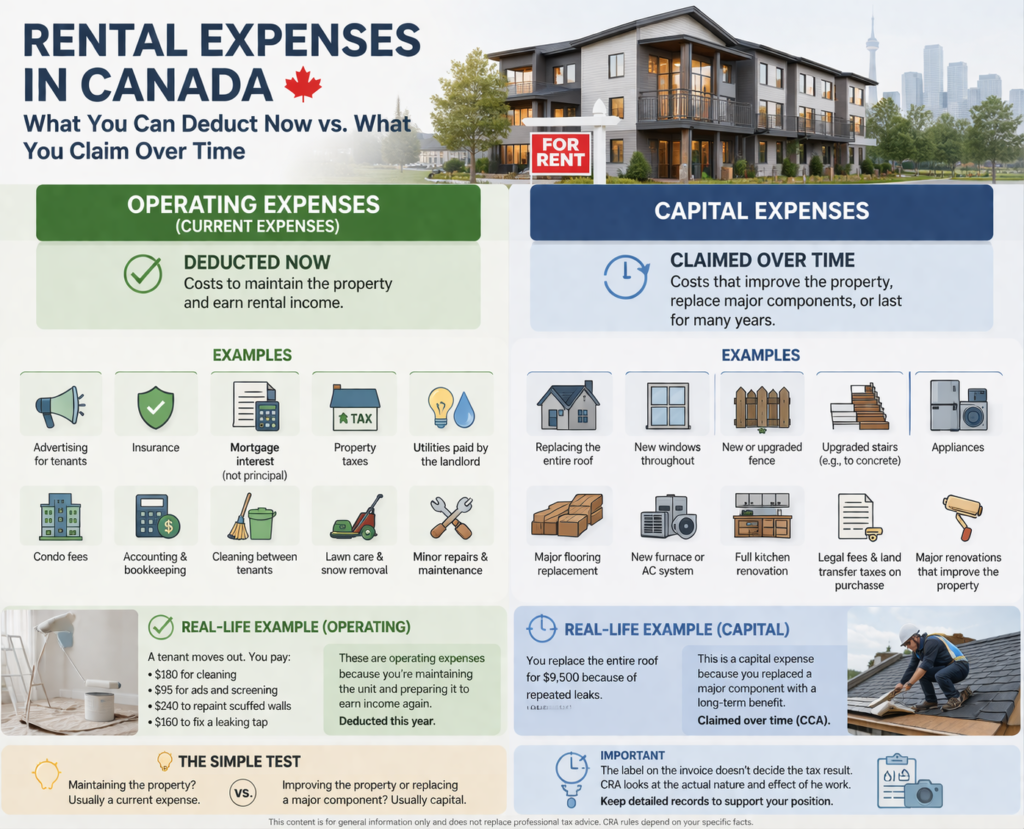
Operating expenses, also called current expenses, are usually the ordinary, recurring costs of earning rental income. CRA describes current or operating expenses as recurring expenses that provide a short-term benefit. A common example is the cost of repairs made to keep a rental property in the same condition as when it was acquired. These amounts are generally deducted in the year they are incurred, assuming they are reasonable and related to earning rental income.
Typical operating expenses for a rental property can include advertising, insurance, mortgage interest, property taxes, utilities, condo fees, bookkeeping or accounting fees, landscaping, cleaning, lawn care, snow removal, and routine repairs and maintenance. CRA’s rental guide and expense pages list these as examples of expenses that may be deductible when they are incurred to earn rental income.
A key point here is that mortgage interest may be deductible, but mortgage principal is not. That distinction often surprises new landlords. The fact that cash left your bank account does not automatically make the full payment deductible for tax purposes. CRA’s rental expense guidance distinguishes deductible interest from non-deductible capital amounts.
What are capital expenses?
Capital expenses are different. CRA generally treats an expense as capital when it provides a lasting benefit, improves the property beyond its original condition, extends its useful life, or replaces a major component. CRA’s guidance on current versus capital expenses says that renovations and expenses that extend the useful life of a property or improve it beyond its original condition are usually capital expenses. CRA also notes that capital expenditures generally provide a benefit that lasts for several years.
In most cases, capital expenses are not deducted all at once like ordinary repairs. Instead, they are generally added to the cost of the building or to a depreciable asset class, and may be claimed over time through capital cost allowance, depending on the nature of the item and the filing position taken. CRA’s rental property guidance explains that capital cost allowance may apply to depreciable property used in a rental activity.
Examples of capital items often include a new roof, new windows, a new furnace, a new appliance, major flooring replacement, a full fence replacement, or a major kitchen renovation. Purchase-related costs can also be capital in nature. CRA’s guidance repeatedly focuses on the lasting benefit, major replacement, or improvement aspect of the work.
The practical test: repair or improvement?
The easiest way to explain the rule is this:
If you are maintaining the property, it is often a current expense.
If you are improving the property or replacing a major part of it, it is often a capital expense. CRA’s pages use exactly this type of reasoning by asking whether the work restores the property to its original condition or improves it beyond that condition.
Another useful CRA concept is that the label on the invoice does not decide the tax result. A contractor may write “repair,” but if the work actually upgrades the property or replaces a major component, CRA may still treat it as capital. The substance of the work matters more than the wording on the bill. That is an inference from CRA’s criteria-based approach, which focuses on the nature and effect of the expenditure rather than the title used by the vendor.
Real-life examples landlords can relate to
Example 1: Repainting a rental unit between tenants
Your tenant moves out and you repaint the walls in the same colour because of scuffs, marks, and normal wear. You also hire cleaners and pay to advertise for a new tenant. In most cases, those costs would be treated as current operating expenses because they are ordinary turnover and maintenance costs that help you continue earning rental income without improving the unit beyond its original condition.
Example 2: Roof patch vs. full roof replacement
Suppose you pay a roofer to patch a localized leak after a storm. That is usually much closer to a repair. But if the entire roof is stripped and replaced because it has reached the end of its life, CRA is far more likely to view that as a capital expense because a major component of the property has been replaced and the benefit lasts for years.
Example 3: Fixing part of a deck vs. building a new upgraded deck
If you replace a few damaged boards and tighten railings, that usually looks like maintenance. If instead you demolish an old deck and build a larger new composite deck, that is much more likely to be capital because the work goes beyond simple restoration and produces an enduring improvement. CRA’s improvement-versus-restoration framework supports that distinction.
Example 4: Appliance repair vs. buying a new appliance
Paying to repair a fridge or stove already in the rental may often be treated as a current expense if the purpose is simply to keep the unit functioning. Buying a brand-new appliance is usually different, because you are acquiring a separate depreciable asset with lasting value. CRA’s rental property and capital cost allowance pages support this treatment.
Example 5: Basic kitchen repair vs. full kitchen renovation
If cabinet doors are repaired, damaged hardware is replaced, and small sections are patched so the kitchen functions the same way as before, that often points to a current expense. But if you remove the old kitchen and install upgraded cabinets, new counters, and a redesigned layout, that is much more likely to be capital. CRA’s test looks directly at whether the work improves the property beyond its original condition.
A special trap: work done right after purchase
One area landlords often miss is the property they buy in rough condition. CRA says that when you renovate or repair an older building that you bought to make it suitable to rent, that work is considered a capital expense. This is important because some owners assume that anything called a repair is immediately deductible, but work done to put the property into rentable condition can be capital even if it looks like maintenance on the surface.
For example, if you buy a neglected duplex, replace damaged flooring throughout, repaint the entire building, repair old plumbing, and update fixtures before the first tenant moves in, you should be careful. Some or all of those amounts may need capital treatment depending on the facts, especially if the work was necessary to make the property rentable in the first place. CRA specifically flags this situation.
What about mixed invoices?
Some projects contain both repair and improvement elements. For example, a contractor invoice may include a small repair component plus a more significant upgrade. CRA’s folio states that when both current and capital elements can be identified, an appropriate allocation is necessary. CRA also notes that where only a minor part of the expenditure is capital in nature, its practice may be to treat the whole amount as current.
That means landlords should not assume one invoice always equals one tax result. Sometimes the right treatment is to split the bill based on what was actually done. This is especially relevant for partial renovations, insurance repairs with upgrades, or bundled contractor work. CRA support is strongest when the invoice clearly separates labour and materials by task.
Keep documentation that explains the story
Good records matter. CRA’s rental guidance expects landlords to support their income and deductions, and in practice the strongest files usually include the invoice, proof of payment, photos, and a short explanation of what work was done and why. That is especially important for expenses near the line between repair and improvement.
A very practical habit is to keep before-and-after photos for any larger project and to ask contractors for detailed invoices. “Renovation work completed – $8,000” is much weaker support than an invoice that separately lists leak repair, drywall patching, replacement flooring, new cabinets, and appliance installation. The more detail you keep, the easier it is to defend the tax treatment. This is an applied best practice based on CRA’s criteria-driven approach and documentation expectations.
Final thoughts
For Canadian landlords, the question is not just whether money was spent on the property. The real question is what kind of expense it was. If the cost relates to ordinary maintenance, recurring services, or keeping the property in the same condition, it will often be a current operating expense. If it creates a long-term improvement, replaces a major component, or makes the property better than before, it is often capital.
This distinction can materially affect your tax return, your net rental income, and your CRA risk. When in doubt, review the facts carefully before filing, especially for renovations, replacement projects, and work completed right after purchase.